JEE Advanced · Physics

Sound Waves PYQs

20 previous-year questions from Sound Waves in JEE Advanced, 2010–2026, latest first.

Q1JEE Advanced · 17 May 2026 · Paper-1
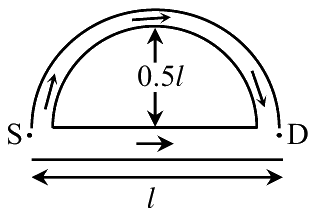
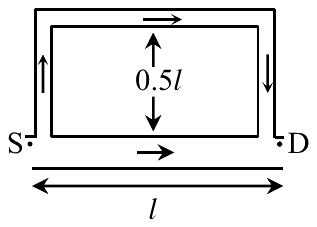
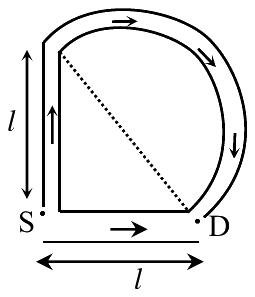
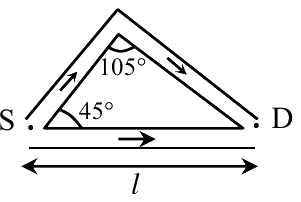
List-I shows four configurations made of straight and semi-circular narrow tubes containing air. A sound wave of wavelength λ = 0.29 m enters these structures at the point S and a sound detector is placed at D. Between the points S and D, the sound travels only through the tubes. List-II contains the possible smallest values of l (refer to the figures) for which the detector D records maximum amplitude. Ignore effects of sharp corners. [Given cos(15∘{}^{∘\circ}) = 0.97] Choose the option that best describes the match between the entries in List-I to those in List-II.
List-I
List-II
(P)figure(1)1.32 m
(Q)figure(2)1.19 m
(R)figure(3)0.51 m
(S)figure(4)0.29 m
(5)0.13 m
Question 1Question 1Question 1Question 1
  1. (A)P →→\rightarrow 4, Q →→\rightarrow 3, R →→\rightarrow 5, S →→\rightarrow 1
  2. (B)P →→\rightarrow 4, Q →→\rightarrow 3, R →→\rightarrow 1, S →→\rightarrow 5
  3. (C)P →→\rightarrow 3, Q →→\rightarrow 4, R →→\rightarrow 1, S →→\rightarrow 2
  4. (D)P →→\rightarrow 3, Q →→\rightarrow 4, R →→\rightarrow 5, S →→\rightarrow 2
Show answer & solution

Answer: D

(P) Δx = (π − 2)l/2 = λ ⇒⇒\Rightarrow l = 2λ/(π − 2) = 0.51 m (3) (Q) Δx = 2l − l = l = λ = 0.29 m (4) (R) Δx = πl/√√\surd2 = λ ⇒⇒\Rightarrow l = √√\surd2λ/π = 0.13 m (5) (S) Triangle angles: 45∘{}^{∘\circ} at S, 105∘{}^{∘\circ} at the top, 30∘{}^{∘\circ} at D. Sine rule (sin 105∘{}^{∘\circ} = cos 15∘{}^{∘\circ} = 0.97): upper path = l(sin 30∘{}^{∘\circ} + sin 45∘{}^{∘\circ})/sin 105∘{}^{∘\circ} = (1.207/0.97)l ≈ 1.244 l Δx ≈ 0.244 l = λ ⇒⇒\Rightarrow l ≈ 0.29/0.244 ≈ 1.19 m (2)
Q2JEE Advanced · 18 May 2025 · Paper-2Numerical answer
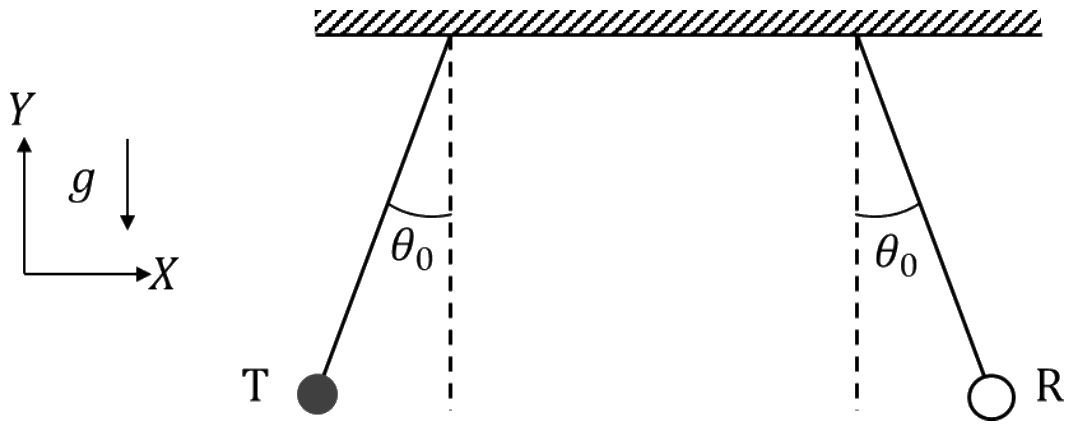
An audio transmitter (T) and a receiver (R) are hung vertically from two identical massless strings of length 8 m with their pivots well separated along the X axis. They are pulled from the equilibrium position in opposite directions along the X axis by a small angular amplitude θ0 = cos−1(0.9) and released simultaneously. If the natural frequency of the transmitter is 660 Hz and the speed of sound in air is 330 m/s, the maximum variation in the frequency (in Hz) as measured by the receiver (Take the acceleration due to gravity g = 10 m/s2) is ______. figure
Question 2
Show answer & solution

Answer: 31.73

Maximum speed of each bob: v′ = √√\surd(2gl(1 − cos θ0)) = √√\surd(2 ××\times 10 ××\times 8 ××\times 0.1) = 4 m/s They swing in opposite directions, so at the lowest point they approach or recede with speed v′ each. fmax=fv+v′v−v′=660×334326≈676.2Hz;fmin=fv−v′v+v′=660×326334≈644.2Hzf_{max} = f\frac{v + v′}{v − v′} = 660 \times \frac{334}{326} ≈ 676.2 Hz; f_{min} = f\frac{v − v′}{v + v′} = 660 \times \frac{326}{334} ≈ 644.2 Hz Maximum variation = fmax − fmin ≈ 32.0 Hz (accepted range 31.19 to 32.27)
Q3JEE Advanced · 26 May 2024 · Paper-1Numerical answer
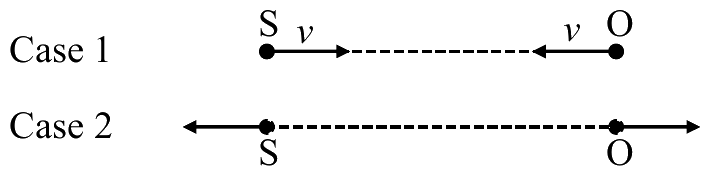
A source (S) of sound has frequency 240 Hz. When the observer (O) and the source move towards each other at a speed v with respect to the ground (as shown in Case 1 in the figure), the observer measures the frequency of the sound to be 288 Hz. However, when the observer and the source move away from each other at the same speed v with respect to the ground (as shown in Case 2 in the figure), the observer measures the frequency of sound to be n Hz. The value of n is ______. figure
Question 3
Show answer & solution

Answer: 200

Case 1:288=240c+vc−v; Case 2:n=240c−vc+v\text{Case }1: 288 = 240\frac{c + v}{c − v};\text{ Case }2: n = 240\frac{c − v}{c + v} Multiplying: 288 ××\times n = 240 ××\times 240 ⇒⇒\Rightarrow n = 200

17 more Sound Waves questions

Practise them free

Practise all 20 Sound Waves PYQs

Untimed with solutions, or as a timed test. Your mistakes are saved so you can retry them.

Start free