JEE Advanced · Physics

Electrostatics PYQs

51 previous-year questions from Electrostatics in JEE Advanced, 2009–2026, latest first.

Q1JEE Advanced · 17 May 2026 · Paper-2One or more correct
Two charges Q1 = q and Q2 = mq are placed at the points P1(a, b) and P2(ma, mb), respectively, in the XY plane, where a, b ≠≠\neq 0 and m ≠≠\neq 0, 1. If V1 is the potential at a point in the XY plane due to charge Q1 and V2 is the potential at that point due to charge Q2. Correct statement(s) for the points at which |V1| = |V2| is/are:
  1. (A)For m = −1, locus of these points is ax + by = 0
  2. (B)For m = 2, the locus of these points is a circle of radius 23a2+b2\frac{2}{3}\sqrt{a^{2} + b^{2}} centered at (23a,23b)(\frac{2}{3}a, \frac{2}{3}b)
  3. (C)For m = −2, the locus of these points is a circle of radius 2√√\surd(a2 + b2) centered at (2a, 2b)
  4. (D)For m = −3, locus of these points is 3bx + 3ay = 0
Show answer & solution

Answer: A, B, C

r2 = |m|r1 ⇒⇒\Rightarrow (m + 1)(x2 + y2) = 2m(ax + by) m = −1: ax + by = 0 ✓; m = 2: 3(x2 + y2) = 4(ax + by) ⇒⇒\Rightarrow centre (2a/3, 2b/3), radius (2/3)√√\surd(a2 + b2) ✓ m = −2: x2 + y2 = 4(ax + by) ⇒⇒\Rightarrow centre (2a, 2b), radius 2√√\surd(a2 + b2) ✓; m = −3 gives a circle ✗
Q2JEE Advanced · 17 May 2026 · Paper-2One or more correct
Consider an electric dipole comprising two charges +q and −q each with mass m, separated by a fixed distance d and initially at rest with its dipole moment pointing along î. A uniform electric field Eĵ is turned on at time t = 0 and it is turned off at t = tf, when the dipole moment makes an angle θf with î. Neglecting any sources of energy loss, correct option(s) is/are
  1. (A)The center of mass of the dipole is deflected towards ĵ in the presence of the field
  2. (B)If the magnitude of the final angular velocity ωf = √√\surd(2qE/md) then θf = π/6
  3. (C)If θf = π/4, then the change in kinetic energy of the dipole is given by 2√√\surd3 qEd
  4. (D)For θf = π/4, the dipole rotates around its center of mass with a constant angular velocity after t > tf
Show answer & solution

Answer: B, D

Net force zero ⇒⇒\Rightarrow CM not deflected ✗ I = md2/2; ΔKE = qEd sin θf = (1/2)Iωf2 ωf2 = 2qE/md ⇒⇒\Rightarrow sin θf = 1/2 ⇒⇒\Rightarrow θf = π/6 ✓ θf = π/4 ⇒⇒\Rightarrow ΔKE = qEd/√√\surd2 ✗; after field off no torque ⇒⇒\Rightarrow constant ω ✓
Q3JEE Advanced · 18 May 2025 · Paper-1
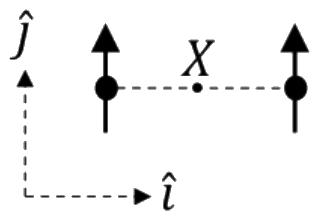
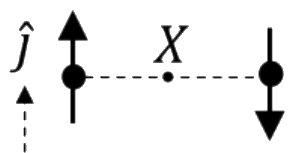
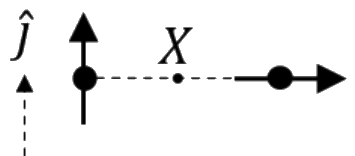
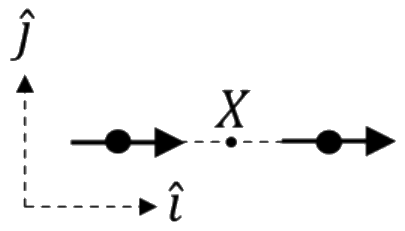
List-I shows four configurations, each consisting of a pair of ideal electric dipoles. Each dipole has a dipole moment of magnitude p, oriented as marked by arrows in the figures. In all the configurations the dipoles are fixed such that they are at a distance 2r apart along the x direction. The midpoint of the line joining the two dipoles is X. The possible resultant electric fields E⃗ at X are given in List-II. Choose the option that describes the correct match between the entries in List-I to those in List-II.
List-I
List-II
(P)figure(1)E⃗ = 0
(Q)figure(2)E⃗=−p2πε0r3ȷ^E⃗ = −\frac{p}{2πε_{0}r^{3}}ĵ
(R)figure(3)E⃗=−p4πε0r3(ı^−ȷ^)E⃗ = −\frac{p}{4πε_{0}r^{3}}(î − ĵ)
(S)figure(4)E⃗=p4πε0r3(2ı^−ȷ^)E⃗ = \frac{p}{4πε_{0}r^{3}}(2î − ĵ)
(5)E⃗=pπε0r3ı^E⃗ = \frac{p}{πε_{0}r^{3}}î
Question 3Question 3Question 3Question 3
  1. (A)P →→\rightarrow 3, Q →→\rightarrow 1, R →→\rightarrow 2, S →→\rightarrow 4
  2. (B)P →→\rightarrow 4, Q →→\rightarrow 5, R →→\rightarrow 3, S →→\rightarrow 1
  3. (C)P →→\rightarrow 2, Q →→\rightarrow 1, R →→\rightarrow 4, S →→\rightarrow 5
  4. (D)P →→\rightarrow 2, Q →→\rightarrow 1, R →→\rightarrow 3, S →→\rightarrow 5
Show answer & solution

Answer: C

Equatorial field of a dipole =−kpr3; axial field =2kpr3, with k =14πε0\text{Equatorial field of a dipole }= −\frac{kp}{r^{3}};\text{ axial field }= \frac{2kp}{r^{3}},\text{ with k }= \frac{1}{4πε_{0}} (P) Both dipoles along ȷ^,X on their equatorial lines:E⃗net=−2kpr3ȷ^=−p2πε0r3ȷ^⇒P→2(P)\text{ Both dipoles along }ĵ, X\text{ on their equatorial lines}: E⃗_{net} = −\frac{2kp}{r^{3}}ĵ = −\frac{p}{2πε_{0}r^{3}}ĵ \Rightarrow P \rightarrow 2 (Q) Opposite dipoles on equatorial lines: fields cancel ⇒⇒\Rightarrow E⃗net = 0 ⇒⇒\Rightarrow Q →→\rightarrow 1 (R) One along ȷ^(equatorial) and one along ı^(axial):E⃗=2kpr3ı^−kpr3ȷ^=p4πε0r3(2ı^−ȷ^)⇒R→4(R)\text{ One along }ĵ (equatorial)\text{ and one along }î (axial): E⃗ = \frac{2kp}{r^{3}}î − \frac{kp}{r^{3}}ĵ = \frac{p}{4πε_{0}r^{3}}(2î − ĵ) \Rightarrow R \rightarrow 4 (S) Both along ı^,X on their axes:E⃗=4kpr3ı^=pπε0r3ı^⇒S→5(S)\text{ Both along }î, X\text{ on their axes}: E⃗ = \frac{4kp}{r^{3}}î = \frac{p}{πε_{0}r^{3}}î \Rightarrow S \rightarrow 5

48 more Electrostatics questions

Practise them free

Practise all 51 Electrostatics PYQs

Untimed with solutions, or as a timed test. Your mistakes are saved so you can retry them.

Start free