JEE Advanced · Physics

Fluid Mechanics PYQs

36 previous-year questions from Fluid Mechanics in JEE Advanced, 2009–2026, latest first.

Q1JEE Advanced · 17 May 2026 · Paper-2Numerical answer
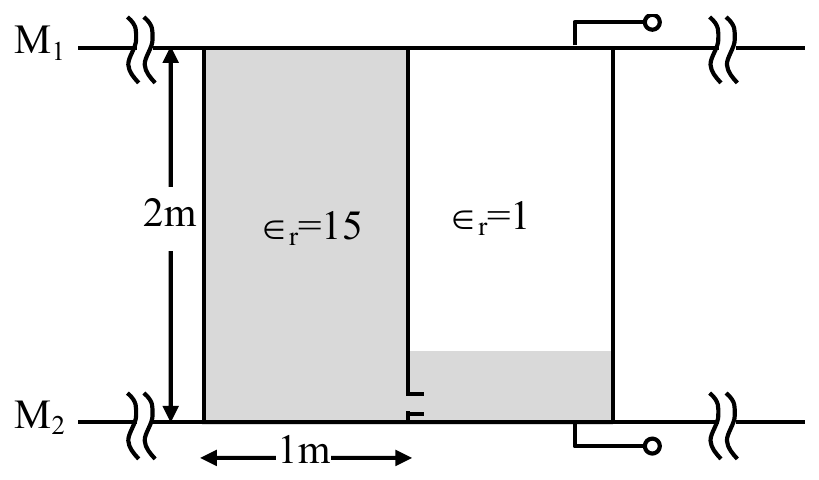
Question Stem (Questions 15–16) A container of height 2 m, length 2 m and breadth 1 m is made of insulating vertical walls and two large area horizontal metal plates (M1 and M2) which extend far beyond the vertical walls in all directions. The container is partitioned into two equal chambers with a thin insulating vertical wall. The partition wall contains a small hole of cross-sectional area √√\surd10 cm2 near its bottom edge. Initially the hole is closed and the left chamber of the container is completely filled with a liquid of dielectric constant εr = 15 and the right chamber is empty (εr = 1). At time t = 0, the hole is opened and the liquid flows from the left chamber to the right chamber. In both the chambers, the space above the liquid has εr = 1 and is maintained at atmospheric pressure. The schematic of the container at a time t > 0 is shown in the figure. [Given: acceleration due to gravity is 10 m s−2.] figure The height (in m) of the liquid in left chamber at t = 500 s is
Question 1
Show answer & solution

Answer: 1.25

Let h = level in the right chamber; head difference (2 − h) − h ⇒⇒\Rightarrow v = 2√√\surd(g(1 − h)) Area of each chamber A = 1 m2: a v = A dh/dt ⇒⇒\Rightarrow 1 − h = (1 − (a/A)√√\surdg t)2 = (1 − 0.5)2 = 0.25 h = 0.75 m ⇒⇒\Rightarrow left chamber level = 2 − 0.75 = 1.25 m
Q2JEE Advanced · 26 May 2024 · Paper-1Numerical answer
Two large, identical water tanks, 1 and 2, kept on the top of a building of height H, are filled with water up to height h in each tank. Both the tanks contain an identical hole of small radius on their sides, close to their bottom. A pipe of the same internal radius as that of the hole is connected to tank 2, and the pipe ends at the ground level. When the water flows from the tanks 1 and 2 through the holes, the times taken to empty the tanks are t1 and t2, respectively. If H = (16/9)h, then the ratio t1/t2 is ______.
Show answer & solution

Answer: 3

Tank 1:A(−dydt)=a2gy⇒t1=Aa2hg\text{Tank }1: A(−\frac{dy}{dt}) = a\sqrt{2gy} \Rightarrow t_{1} = \frac{A}{a}\sqrt{\frac{2h}{g}} Tank 2(outlet at ground):A(−dydt)=a2g(H+y)⇒t2=Aa2g(H+h−H)\text{Tank }2 (\text{outlet at ground}): A(−\frac{dy}{dt}) = a\sqrt{2g(H + y)} \Rightarrow t_{2} = \frac{A}{a}\sqrt{\frac{2}{g}}(\sqrt{H + h} − \sqrt{H}) With H =16h9:H+h−H=h(53−43)=h3\text{With H }= \frac{16h}{9}: \sqrt{H + h} − \sqrt{H} = \sqrt{h}(\frac{5}{3} − \frac{4}{3}) = \frac{\sqrt{h}}{3} t1/t2 = 3
Q3JEE Advanced · 26 May 2024 · Paper-2One or more correct
A table tennis ball has radius (3/2) ××\times 10−2 m and mass (22/7) ××\times 10−3 kg. It is slowly pushed down into a swimming pool to a depth of d = 0.7 m below the water surface and then released from rest. It emerges from the water surface at speed v, without getting wet, and rises up to a height H. Which of the following option(s) is(are) correct? [Given: π = 22/7, g = 10 ms−2, density of water = 1 ××\times 103 kg m−3, viscosity of water = 1 ××\times 10−3 Pa-s.]
  1. (A)The work done in pushing the ball to the depth d is 0.077 J.
  2. (B)If we neglect the viscous force in water, then the speed v = 7 m/s.
  3. (C)If we neglect the viscous force in water, then the height H = 1.4 m.
  4. (D)The ratio of the magnitudes of the net force excluding the viscous force to the maximum viscous force in water is 500/9.
Show answer & solution

Answer: A, B, D

Volume V =43×227×(1.5×10−2)3=997×10−6m3; buoyancy =ρVg=0.1414N; weight mg =0.0314N\text{Volume V }= \frac{4}{3} \times \frac{22}{7} \times (1.5 \times 10^{−2})^{3} = \frac{99}{7} \times 10^{−6} m^{3};\text{ buoyancy }= ρVg = 0.1414 N;\text{ weight mg }= 0.0314 N Net upward force (excluding viscosity) = 0.11 N (A) Pushed slowly: W = (ρVg − mg)d = 0.11 ××\times 0.7 = 0.077 J ⇒⇒\Rightarrow true (B) Without viscosity: ½mv2 = 0.077 ⇒⇒\Rightarrow v2 = 0.077 ××\times 2 ××\times 7/(22 ××\times 10−3) = 49 ⇒⇒\Rightarrow v = 7 m/s ⇒⇒\Rightarrow true (C) H = v2/2g = 49/20 = 2.45 m ⇒⇒\Rightarrow false (D) Maximum viscous force (v = 7 m/s): 6πηrv = 6 ××\times (22/7) ××\times 10−3 ××\times 1.5 ××\times 10−2 ××\times 7 = 1.98 ××\times 10−3 N ⇒⇒\Rightarrow ratio = 0.11/(1.98 ××\times 10−3) = 500/9 ⇒⇒\Rightarrow true

33 more Fluid Mechanics questions

Practise them free

Practise all 36 Fluid Mechanics PYQs

Untimed with solutions, or as a timed test. Your mistakes are saved so you can retry them.

Start free