JEE Advanced · Physics

Simple Harmonic Motion PYQs

22 previous-year questions from Simple Harmonic Motion in JEE Advanced, 2009–2026, latest first.

Q1JEE Advanced · 17 May 2026 · Paper-1Numerical answer
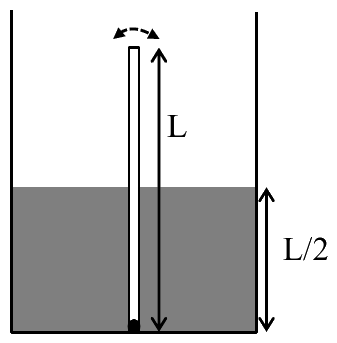
A tank contains two immiscible liquids of densities 6ρ and 2ρ. The higher density liquid is filled up to a height L/2 from the bottom. A thin rod of density ρ and length L is fully immersed and hinged at the bottom so that it can oscillate freely, as shown in the figure. If the rod is slightly disturbed from its equilibrium, the time period of small oscillations is (2π/n)√√\surd(L/g), where g is the acceleration due to gravity. The value of n is figure
Question 1
Show answer & solution

Answer: 1.73

Torque about hinge (small θ): buoyancy 2ρ(L/2)Ag at 3L/4, 6ρ(L/2)Ag at L/4, weight ρLAg at L/2 τ = ρAgL2(3/4 + 3/4 − 1/2)θ = ρAgL2θ (restoring); I = ρAL3/3 α = −(3g/L)θ ⇒⇒\Rightarrow T = 2π√√\surd(L/3g) ⇒⇒\Rightarrow n = √√\surd3 ≈ 1.73
Q2JEE Advanced · 18 May 2025 · Paper-1
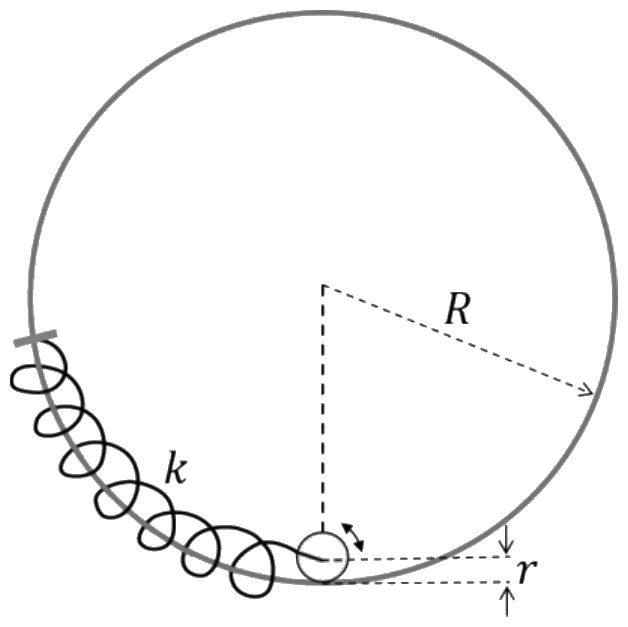
The center of a disk of radius r and mass m is attached to a spring of spring constant k, inside a ring of radius R >r as shown in the figure. The other end of the spring is attached on the periphery of the ring. Both the ring and the disk are in the same vertical plane. The disk can only roll along the inside periphery of the ring, without slipping. The spring can only be stretched or compressed along the periphery of the ring, following the Hooke’s law. In equilibrium, the disk is at the bottom of the ring. Assuming small displacement of the disc, the time period of oscillation of center of mass of the disk is written as T =2πω. The correct expression for ω is (g is the acceleration due to gravity):\text{The center of a disk of radius r and mass m is attached to a spring of spring constant k},\text{ inside a ring of radius R }> r\text{ as shown in the figure}.\text{ The other end of the spring is attached on the periphery of the ring}.\text{ Both the ring and the disk are in the same vertical plane}.\text{ The disk can only roll along the inside periphery of the ring},\text{ without slipping}.\text{ The spring can only be stretched or compressed along the periphery of the ring},\text{ following the Hooke}’s\text{ law}.\text{ In equilibrium},\text{ the disk is at the bottom of the ring}.\text{ Assuming small displacement of the disc},\text{ the time period of oscillation of center of mass of the disk is written as T }= \frac{2π}{ω}.\text{ The correct expression for }ω\text{ is }(g\text{ is the acceleration due to gravity}): figure
Question 2
  1. (A)23(gR−r+km)\sqrt{\frac{2}{3}(\frac{g}{R − r} + \frac{k}{m})}
  2. (B)2g3(R−r)+km\sqrt{\frac{2g}{3(R − r)} + \frac{k}{m}}
  3. (C)16(gR−r+km)\sqrt{\frac{1}{6}(\frac{g}{R − r} + \frac{k}{m})}
  4. (D)14(gR−r+km)\sqrt{\frac{1}{4}(\frac{g}{R − r} + \frac{k}{m})}
Show answer & solution

Answer: A

Let x be the displacement of the centre along the arc (x = (R − r)θ). Forces along the path: spring kx and gravity mg sin θ ≈ mg x/(R − r), opposed by friction f. kx+mgxR−r−f=ma; for rolling, fr =12mr2α⇒f=ma2kx + mg\frac{x}{R − r} − f = ma;\text{ for rolling},\text{ fr }= \frac{1}{2}mr^{2}α \Rightarrow f = \frac{ma}{2} ∴(k+mgR−r)x=−32ma⇒a=−23(km+gR−r)x∴ (k + \frac{mg}{R − r})x = −\frac{3}{2}ma \Rightarrow a = −\frac{2}{3}(\frac{k}{m} + \frac{g}{R − r})x Comparing with a =−ω2x:ω=23(gR−r+km)\text{Comparing with a }= −ω^{2}x: ω = \sqrt{\frac{2}{3}(\frac{g}{R − r} + \frac{k}{m})}
Q3JEE Advanced · 18 May 2025 · Paper-1Numerical answer
A person sitting inside an elevator performs a weighing experiment with an object of mass 50kg. Suppose that the variation of the height y (in m) of the elevator, from the ground, with time t (in s) is given by y =8[1+sin⁡(2πtT)], where T =40πs. Taking acceleration due to gravity,g=10m/s2, the maximum variation of the object’s weight (in N) as observed in the experiment is ____A\text{ person sitting inside an elevator performs a weighing experiment with an object of mass }50 kg.\text{ Suppose that the variation of the height y }(\text{in m})\text{ of the elevator},\text{ from the ground},\text{ with time t }(\text{in s})\text{ is given by y }= 8[1 + \sin (\frac{2πt}{T})],\text{ where T }= 40π s.\text{ Taking acceleration due to gravity}, g = 10 m/s^{2},\text{ the maximum variation of the object}’s\text{ weight }(\text{in N})\text{ as observed in the experiment is }\_\_\_\_
Show answer & solution

Answer: 2

y=8+8sin⁡2πtT: the elevator performs SHM with A =8m and ω=2πT.y = 8 + 8\sin \frac{2πt}{T}:\text{ the elevator performs SHM with A }= 8 m\text{ and }ω = \frac{2π}{T}. Apparent weight = m(g + a); the acceleration varies between +ω2A and −ω2A. ΔW=m×2ω2A=2×50×(2π40π)2×8=2×50×1400×8=2NΔW = m \times 2ω^{2}A = 2 \times 50 \times (\frac{2π}{40π})^{2} \times 8 = 2 \times 50 \times \frac{1}{400} \times 8 = 2 N

19 more Simple Harmonic Motion questions

Practise them free

Practise all 22 Simple Harmonic Motion PYQs

Untimed with solutions, or as a timed test. Your mistakes are saved so you can retry them.

Start free