JEE Advanced · Physics

Laws of Motion PYQs

13 previous-year questions from Laws of Motion in JEE Advanced, 2009–2021, latest first.

Q1JEE Advanced · 3 Oct 2021 · Paper-2One or more correct
One end of a horizontal uniform beam of weight W and length L is hinged on a vertical wall at point O and its other end is supported by a light inextensible rope. The other end of the rope is fixed at point Q, at a height L above the hinge at point O. A block of weight αW is attached at the point P of the beam, as shown in the figure (not to scale). The rope can sustain a maximum tension of (2√√\surd2)W. Which of the following statement(s) is(are) correct? figure
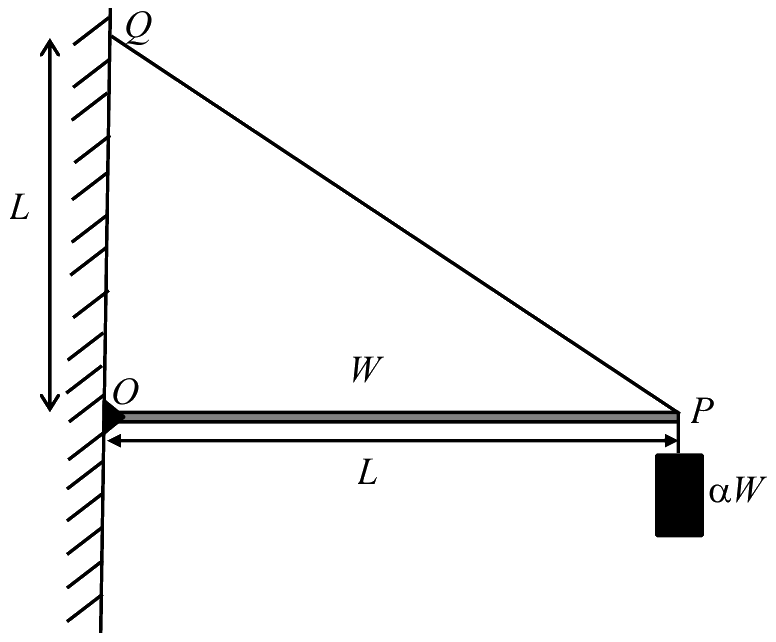
Question 1
  1. (A)The vertical component of reaction force at O does not depend on α
  2. (B)The horizontal component of reaction force at O is equal to W for α = 0.5
  3. (C)The tension in the rope is 2W for α = 0.5
  4. (D)The rope breaks if α > 1.5
Show answer & solution

Answer: A, B, D

Rope makes 45∘{}^{∘\circ} with the beam. Torque about O: (T/√√\surd2)L = W(L/2) + αWL ⇒⇒\Rightarrow T = √√\surd2(W/2 + αW) Rx = T/√√\surd2 = W/2 + αW; torque about P: RyL = W(L/2) ⇒⇒\Rightarrow Ry = W/2 (independent of α) ⇒⇒\Rightarrow (A) true α = 0.5: Rx = W ⇒⇒\Rightarrow (B) true; T = √√\surd2W ⇒⇒\Rightarrow (C) false T = 2√√\surd2W ⇒⇒\Rightarrow W/2 + αW = 2W ⇒⇒\Rightarrow α = 1.5; the rope breaks for α > 1.5 ⇒⇒\Rightarrow (D) true
Q2JEE Advanced · 27 Sept 2020 · Paper-1Numerical answer
Put a uniform meter scale horizontally on your extended index fingers with the left one at 0.00 cm and the right one at 90.00 cm. When you attempt to move both the fingers slowly towards the center, initially only the left finger slips with respect to the scale and the right finger does not. After some distance, the left finger stops and the right one starts slipping. Then the right finger stops at a distance xR from the center (50.00 cm) of the scale and the left one starts slipping again. This happens because of the difference in the frictional forces on the two fingers. If the coefficients of static and dynamic friction between the fingers and the scale are 0.40 and 0.32, respectively, the value of xR (in cm) is ______.
Show answer & solution

Answer: 25.6

Torques about the centre: N1xL = N2xR at every stage. Left stops when 0.32N1 = 0.40N2 with right finger at 40 cm: N1xL = N2(40) and N1 = 1.25N2 ⇒⇒\Rightarrow xL = 32 cm Right stops when 0.40N1 = 0.32N2 ⇒⇒\Rightarrow N2 = 1.25N1: N1(32) = N2xR ⇒⇒\Rightarrow xR = 32/1.25 = 25.6 cm
Q3JEE Advanced · 27 May 2019 · Paper-2One or more correct
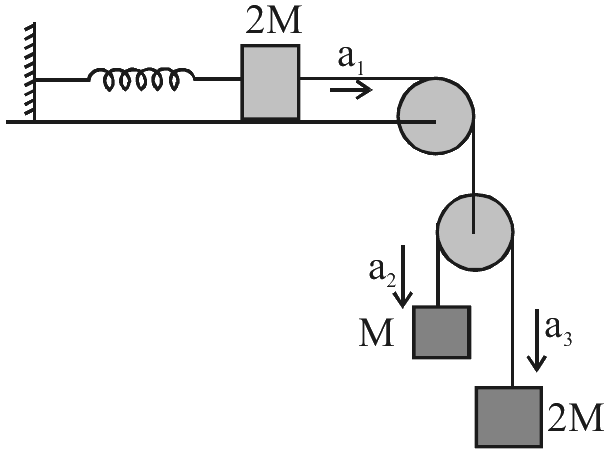
A block of mass 2M is attached to a massless spring with spring-constant k. This block is connected to two other blocks of masses M and 2M using two massless pulleys and strings. The accelerations of the blocks are a1, a2 and a3 as shown in figure. The system is released from rest with the spring in its unstretched state. The maximum extension of the spring is x0. Which of the following option(s) is/are correct? [g is the acceleration due to gravity. Neglect friction] figure
Question 3
  1. (A)x0=4Mgkx_{0} = \frac{4Mg}{k}
  2. (B)When spring achieves an extension of x02 for the first time, the speed of the block connected to the spring is 3gM5k\text{When spring achieves an extension of }\frac{x_{0}}{2}\text{ for the first time},\text{ the speed of the block connected to the spring is }3g\sqrt{\frac{M}{5k}}
  3. (C)a2 − a1 = a1 − a3
  4. (D)At an extension of x04 of the spring, the magnitude of acceleration of the block connected to the spring is 3g10\text{At an extension of }\frac{x_{0}}{4}\text{ of the spring},\text{ the magnitude of acceleration of the block connected to the spring is }\frac{3g}{10}
Show answer & solution

Answer: C

String constraint on the movable pulley: 2a1 = a2 + a3 ⇒⇒\Rightarrow a2 − a1 = a1 − a3 ⇒⇒\Rightarrow (C) ✓ Tension in the hanging pair T = (4M/3)(g − a1); for the 2M block: 2T − kx = 2Ma1 ⇒⇒\Rightarrow a1 = (8Mg − 3kx)/(14M) SHM about x = 8Mg/3k ⇒⇒\Rightarrow x0 = 16Mg/3k ⇒⇒\Rightarrow (A) ✗; speed at x0/2 and acceleration at x0/4 (= 2g/7) do not match (B), (D) ✗

10 more Laws of Motion questions

Practise them free

Practise all 13 Laws of Motion PYQs

Untimed with solutions, or as a timed test. Your mistakes are saved so you can retry them.

Start free