JEE Advanced · Chemistry

Hydrocarbons And Alkyl Halides PYQs

30 previous-year questions from Hydrocarbons And Alkyl Halides in JEE Advanced, 2010–2026, latest first.

Q1JEE Advanced · 17 May 2026 · Paper-1Numerical answer
Treatment of buta-1,3-diyne with NaNH2 (2 equivalents), followed by reaction with excess of trans-CH3–CH=CH–CH2-Br gives X as the major product. The maximum number of carbon atoms that are collinear (in a straight line) in X is ____.
Show answer & solution

Answer: 6

Dianion of the diyne is dialkylated by SN2 ⇒⇒\Rightarrow CH3CH=CH–CH2–C≡C–C≡C–CH2–CH=CHCH3 The four sp carbons and the two attached CH2 carbons are collinear ⇒⇒\Rightarrow 6
Q2JEE Advanced · 18 May 2025 · Paper-1One or more correct
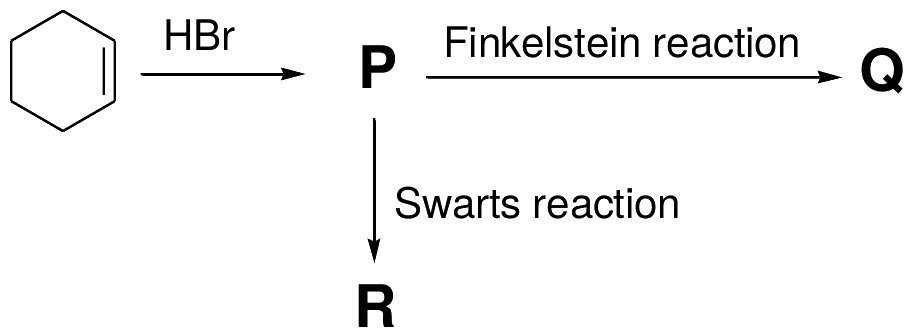
For the reaction sequence given below, the correct statement(s) is(are) figure (In the options, X is any atom other than carbon and hydrogen, and it is different in P, Q and R)
Question 2
  1. (A)C–X bond length in P, Q and R follows the order Q > R > P.
  2. (B)C–X bond enthalpy in P, Q and R follows the order R > P > Q.
  3. (C)Relative reactivity toward SN2 reaction in P, Q and R follows the order P > R > Q.
  4. (D)pKa value of the conjugate acids of the leaving groups in P, Q and R follows the order R > Q > P.
Show answer & solution

Answer: B

P = bromocyclohexane (C–Br); Finkelstein (NaI) gives Q = iodocyclohexane (C–I); Swarts reaction gives R = fluorocyclohexane (C–F). (A) Bond length: C–I > C–Br > C–F ⇒⇒\Rightarrow Q > P > R ⇒⇒\Rightarrow wrong. (B) Bond enthalpy: C–F > C–Br > C–I ⇒⇒\Rightarrow R > P > Q ⇒⇒\Rightarrow correct. (C) SN2 reactivity: Q > P > R ⇒⇒\Rightarrow wrong. (D) pKa of conjugate acids: HF > HBr > HI ⇒⇒\Rightarrow R > P > Q ⇒⇒\Rightarrow wrong.
Q3JEE Advanced · 26 May 2024 · Paper-2
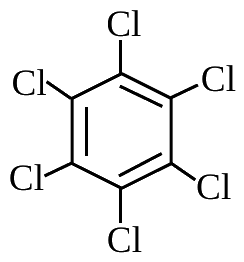
In the following reaction sequences, the major product Q is L-Glucose → i)HI,Δ ii)Cr2O3,775K,10−20 atm \underset{ii) Cr_{2}O_{3}, 775 K, 10−20\text{ atm}}{\xrightarrow{ i) HI, Δ }} P → Cl2(excess) UV \underset{UV}{\xrightarrow{ Cl_{2} (excess) }} Q
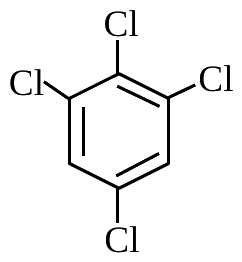
  1. (A)Option A
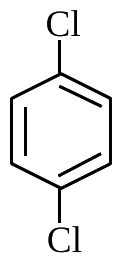
  2. (B)Option B
  3. (C)Option C
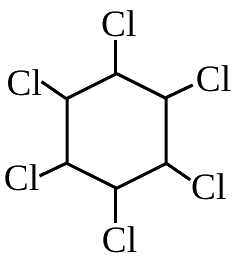
  4. (D)Option D
Show answer & solution

Answer: D

L-Glucose + HI/Δ (complete reduction) →→\rightarrow n-hexane n-Hexane + Cr2O3, 775 K, 10–20 atm (aromatisation) →→\rightarrow benzene (P) Benzene + Cl2 (excess), UV →→\rightarrow free-radical addition ⇒⇒\Rightarrow C6H6Cl6, hexachlorocyclohexane (lindane/BHC) (Q)

27 more Hydrocarbons And Alkyl Halides questions

Practise them free

Practise all 30 Hydrocarbons And Alkyl Halides PYQs

Untimed with solutions, or as a timed test. Your mistakes are saved so you can retry them.

Start free