JEE Advanced · Chemistry

Chemical Thermodynamics PYQs

34 previous-year questions from Chemical Thermodynamics in JEE Advanced, 2009–2026, latest first.

Q1JEE Advanced · 17 May 2026 · Paper-1
An ideal gas (0.5 mol), initially at 2 bar pressure, is compressed at a constant temperature of 600 K in two steps: first against a constant external pressure of P bar (2 < P < 8), and then against constant external pressure of 8 bar. At each step, the compression is stopped only when the pressure of the gas becomes equal to the external pressure. The total work done on the gas in these steps is W. Considering all possible values of P (2 < P < 8) and taking the gas constant as R (in J K−1 mol−1), the minimum value of |W| (in J) is
  1. (A)207 R
  2. (B)600 R
  3. (C)630 R
  4. (D)900 R
Show answer & solution

Answer: B

Irreversible step against Pext: W = −Pext(Vf − Vi) = −nRT(1 − Pext/Pi) W = −300R(1 − P/2) − 300R(1 − 8/P) = 300R(P/2 + 8/P − 2) dW/dP = 0 ⇒⇒\Rightarrow 1/2 = 8/P2 ⇒⇒\Rightarrow P = 4 bar ⇒⇒\Rightarrow Wmin = 300R(2 + 2 − 2) = 600R
Q2JEE Advanced · 18 May 2025 · Paper-1Numerical answer
Considering ideal gas behavior, the expansion work done (in kJ) when 144 g of water is electrolyzed completely under constant pressure at 300 K is ______. Use: Universal gas constant (R) = 8.3 J K−1 mol−1; Atomic mass (in amu): H = 1, O = 16
Show answer & solution

Answer: 29.88

H2O(l)→H2(g)+12O2(g)H_{2}O(l) \rightarrow H_{2}(g) + \frac{1}{2}O_{2}(g); 144 g = 8 mol H2O gives 8 mol H2 + 4 mol O2 Change in gaseous moles Δn = 12 W=−PΔV=−ΔnRT =−12×8.3×3001000 kJ =−29.88kJW = −PΔV = −Δ\text{nRT }= −\frac{12 \times 8.3 \times 300}{1000}\text{ kJ }= −29.88 kJ (expansion work of magnitude 29.88 kJ)
Q3JEE Advanced · 26 May 2024 · Paper-1Numerical answer
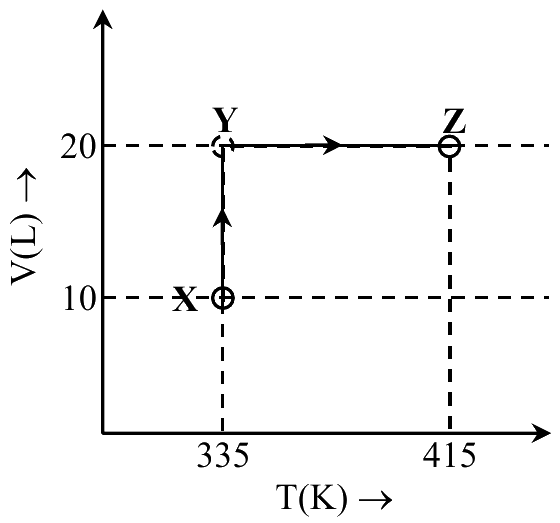
Consider the following volume-temperature (V − T) diagram for the expansion of 5 moles of an ideal monoatomic gas. figure Considering only P-V work is involved, the total change in enthalpy (in Joule) for the transformation of state in the sequence X →→\rightarrow Y →→\rightarrow Z is ______. [Use the given data: Molar heat capacity of the gas for the given temperature range, CV,m = 12 J K−1 mol−1 and gas constant, R = 8.3 J K−1 mol−1]
Question 3
Show answer & solution

Answer: 8120

Enthalpy is a state function: ΔH = nCP(TZ − TX) CP = CV + R = 12 + 8.3 = 20.3 J K−1 mol−1 ΔH = 5 ××\times 20.3 ××\times (415 − 335) = 8120 J

31 more Chemical Thermodynamics questions

Practise them free

Practise all 34 Chemical Thermodynamics PYQs

Untimed with solutions, or as a timed test. Your mistakes are saved so you can retry them.

Start free