JEE Main · Physics

Properties of Solids and Liquids PYQs

172 previous-year questions from Properties of Solids and Liquids in JEE Main, 2013–2026, latest first.

Q1JEE Main · 6 Apr 2026 · Shift-I
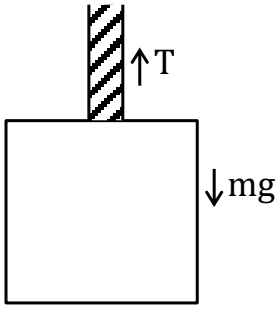
A lift of mass 1600 kg is supported by thick iron wire. If the maximum stress which the wire can withstand is 4×1084\times 10^{8} N/m2 and its radius is 4 mm, then maximum acceleration the lift can take is ____ m/s2. (take g = 10 m/s2 and π = 3.14)
  1. (A)2.56
  2. (B)3.89
  3. (C)4.32
  4. (D)5.16
Show answer & solution

Answer: A

figure T−mg=ma ⇒ σπr2−mg=maT−mg=ma \Rightarrow  σπr^{2}−mg=ma 4×108×3.14×(4×10−3)2−16000=1600a4\times 10^{8}\times 3.14\times \left(4\times 10^{−3}\right)^{2}−16000=1600a 20096−16000=1600a ⇒ a=2.56 m/s220096−16000=1600a \Rightarrow  a=2.56 m/s^{2}
Solution
Q2JEE Main · 6 Apr 2026 · Shift-I
The two wires A and B of equal cross-section but of different materials are joined together. The ratio of Young’s modulus of wire A and wire B is 20/11. When the joined wire is kept under certain tension the elongations in the wires A and B are equal. If the length of wire A is 2.2 m, then the length of wire B is ____ m.
  1. (A)1.1
  2. (B)2.22
  3. (C)1.21
  4. (D)4.44
Show answer & solution

Answer: C

Δℓ=TℓYAΔℓ=\frac{Tℓ}{YA}; with equal ΔℓΔℓ, T and A: ℓ∝Yℓ∝Y ℓ1ℓ2=Y1Y2=2011\frac{ℓ_{1}}{ℓ_{2}}=\frac{Y_{1}}{Y_{2}}=\frac{20}{11} ∵ ℓ1=2.2 m ∴ ℓ2=2.2×1120=1.21 m∵ ℓ_{1}=2.2 m ∴ ℓ_{2}=2.2\times \frac{11}{20}=1.21 m
Q3JEE Main · 6 Apr 2026 · Shift-II
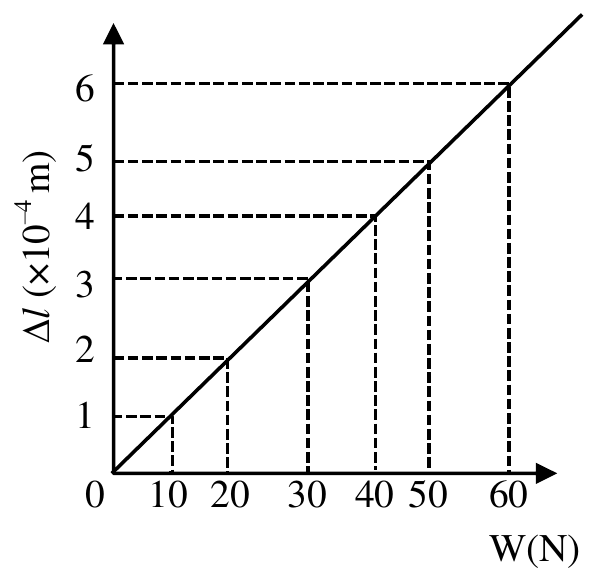
Figure represents the extension (Δl) of a wire of length 1 meter, suspended from the ceiling of the room at one end with load W connected to the other end. If the cross- sectional area of the wire is 10−5 m2 then the Young’s modulus of the wire is ___N/m2. figure
Question 3
  1. (A)1.0×10111.0\times 10^{11}
  2. (B)2.0×10102.0\times 10^{10}
  3. (C)1.0×10101.0\times 10^{10}
  4. (D)2.0×10112.0\times 10^{11}
Show answer & solution

Answer: C

ΔℓW=slope=1×10−410=10−5 m/N ⇒ WΔℓ=105 N/m\frac{Δℓ}{W}=slope=\frac{1\times 10^{−4}}{10}=10^{−5} m/N \Rightarrow  \frac{W}{Δℓ}=10^{5} N/m Y=F/AΔℓ/ℓ=(WΔℓ)ℓA=105×110−5=1010 N/m2Y=\frac{F/A}{Δℓ/ℓ}=\left(\frac{W}{Δℓ}\right)\frac{ℓ}{A}=\frac{10^{5}\times 1}{10^{−5}}=10^{10} N/m^{2}

169 more Properties of Solids and Liquids questions

Practise them free

Practise all 172 Properties of Solids and Liquids PYQs

Untimed with solutions, or as a timed test. Your mistakes are saved so you can retry them.

Start free