JEE Main · Mathematics

Quadratic Equations PYQs

134 previous-year questions from Quadratic Equations in JEE Main, 2013–2026, latest first.

Q1JEE Main · 6 Apr 2026 · Shift-I
Let one root of the quadratic equation in x: (k2−15k+27)x2+9(k−1)x+18=0\left(k^{2}−15k+27\right)x^{2}+9(k−1)x+18=0 be twice the other. Then the length of the latus rectum of the parabola y2=6kxy^{2}=6kx is equal to:
  1. (A)4
  2. (B)6
  3. (C)8
  4. (D)12
Show answer & solution

Answer: D

α+2α=−9(k−1)k2−15k+27=3α   …(1)α+2α=\frac{−9(k−1)}{k^{2}−15k+27}=3α   …(1) α×2α=18k2−15k+27=2α2   …(2)\begin{array}{c}α\times 2α=\frac{18}{k^{2}−15k+27}=2α^{2}   …(2)\end{array} solving (1) & (2) k=2k=2 ⇒⇒\Rightarrow parabola will be y2=6kx=12xy^{2}=6kx=12x length of latus rectum =12=12
Q2JEE Main · 6 Apr 2026 · Shift-II
Consider the quadratic equation (n2−2n+2)x2−3x+(n2−2n+2)2=0,n∈R\left(n^{2}−2n+2\right)x^{2}−3x+\left(n^{2}−2n+2\right)^{2}=0,n\in R. Let αα be the minimum value of the product of its roots and ββ be the maximum value of the sum of its roots. Then the sum of the first six terms of the G.P., whose first term is αα and the common ratio is αβ\frac{α}{β}, is :
  1. (A)6137\frac{61}{37}
  2. (B)12181\frac{121}{81}
  3. (C)364243\frac{364}{243}
  4. (D)1093729\frac{1093}{729}
Show answer & solution

Answer: C

α=n2−2n+2α=(n−1)2+1\begin{matrix}&α=n^{2}−2n+2\\&α=(n−1)^{2}+1\end{matrix} ∴ minimum value of αα is 1 Similarly β=3(n−1)2+1\text{Similarly }β=\frac{3}{(n−1)^{2}+1} ∴ maximum value of ββ is 3 required G.P. is 1,13,132,…\text{required G}.P.\text{ is }1,\frac{1}{3},\frac{1}{3^{2}},… S6=1(1−(13)6)1−13=32[1−(13)6]=364243S_{6}=\frac{1\left(1−\left(\frac{1}{3}\right)^{6}\right)}{1−\frac{1}{3}}=\frac{3}{2}\left[1−\left(\frac{1}{3}\right)^{6}\right]=\frac{364}{243}
Q3JEE Main · 6 Apr 2026 · Shift-II
Let lim⁡x→2 (tan⁡(x−2))(rx2+(p−2)x−2p)(x−2)2=5\lim\limits_{x\to 2} \frac{(\tan (x−2))\left(rx^{2}+(p−2)x−2p\right)}{(x−2)^{2}}=5 for some r,p∈Rr,p\in R. If the set of all possible values of q , such that the roots of the equation rx2−px+q=0rx^{2}−px+q=0 lie in ( 0,2 ), be the interval ( α,β]α,β], then 4(α+β)4(α+β) equals.
  1. (A)11
  2. (B)13
  3. (C)17
  4. (D)21
Show answer & solution

Answer: C

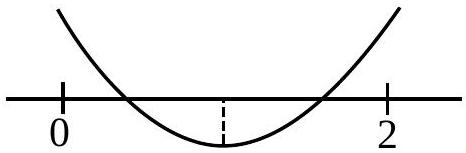
lim⁡x→2 tan⁡(x−2)x−2⋅[rx2+(p−2)x−2p]x−2=5⇒lim⁡x→2 rx2−2x+p(x−2)x−2=5∵Dr→0∴Nr→0⇒r=1⇒lim⁡x→2 x(x−2)+p(x−2)x−2=5⇒2+p=5⇒p=3\begin{matrix}& \lim\limits_{x\to 2} \frac{\tan (x−2)}{x−2}⋅\frac{\left[rx^{2}+(p−2)x−2p\right]}{x−2}=5\\& \Rightarrow \lim\limits_{x\to 2} \frac{rx^{2}−2x+p(x−2)}{x−2}=5\\& ∵D^{r}\rightarrow 0∴N^{r}\rightarrow 0\Rightarrow r=1\\& \Rightarrow \lim\limits_{x\to 2} \frac{x(x−2)+p(x−2)}{x−2}=5\\& \Rightarrow 2+p=5\\& \Rightarrow p=3\end{matrix} Now, quadratic equation is x2−3x+q=0x^{2}−3x+q=0 its both roots lie in (0,2)(0,2) figure D≥0,0<−b2a<2,f(0)>0,f(2)>0⇒9−4q≥0 and q>2⇒q∈(2,94]α=2,β=94⇒4(2+94)=17\begin{matrix}&D\geq 0, 0<\frac{−b}{2a}<2, f(0)>0, f(2)>0\\& \Rightarrow 9−4q\geq 0\text{ and }q>2\\& \Rightarrow q\in \left(2,\frac{9}{4}\right]\\&α=2,β=\frac{9}{4}\Rightarrow 4\left(2+\frac{9}{4}\right)=17\end{matrix}
Solution

131 more Quadratic Equations questions

Practise them free

Practise all 134 Quadratic Equations PYQs

Untimed with solutions, or as a timed test. Your mistakes are saved so you can retry them.

Start free