JEE Main · Mathematics

Monotonicity PYQs

78 previous-year questions from Monotonicity in JEE Main, 2013–2026, latest first.

Q1JEE Main · 6 Apr 2026 · Shift-II
Let A=∣13−121α01−1∣A=\left|\begin{matrix}1&3&−1\\2&1&α\\0&1&−1\end{matrix}\right| be a singular matrix. Let f(x)=∫0x (t2+2t+3)dt,x∈[1,α]f(x)=\int_{0}^{x} \left(t^{2}+2t+3\right)dt,x\in [1,α]. If M and m are respectively the maximum and the minimum values of ff in [1,α][1,α] then 3(M−m)3(M−m) is equal to :
  1. (A)64
  2. (B)68
  3. (C)72
  4. (D)76
Show answer & solution

Answer: B

∣A∣=0⇒1.(−1−α)−3(−2−0)−1(2−0)=0⇒α=3f(x)=∫0x  (t2+2t+3)dt;x∈[1,3]f(x)=x33+x2+3xf′(x)=x2+2x+3  where D<0⇒f(x) is strictly increasing M=f(3)=9+9+9=27m=f(1)=13+1+3=1333(M−m)=3(27−133)=68\begin{matrix}& |A|=0\\& \Rightarrow 1.(−1−α)−3(−2−0)−1(2−0)=0\\& \Rightarrow α=3\\&f(x)=\int_{0}^{x}  \left(t^{2}+2t+3\right)dt;x\in [1,3]\\&f(x)=\frac{x^{3}}{3}+x^{2}+3x\\&f^{′}(x)=x^{2}+2x+3\text{  where }D<0\\& \Rightarrow f(x)\text{ is strictly increasing }\\&M=f(3)=9+9+9=27\\&m=f(1)=\frac{1}{3}+1+3=\frac{13}{3}\\&3(M−m)=3\left(27−\frac{13}{3}\right)=68\end{matrix}
Q2JEE Main · 2 Apr 2026 · Shift-I
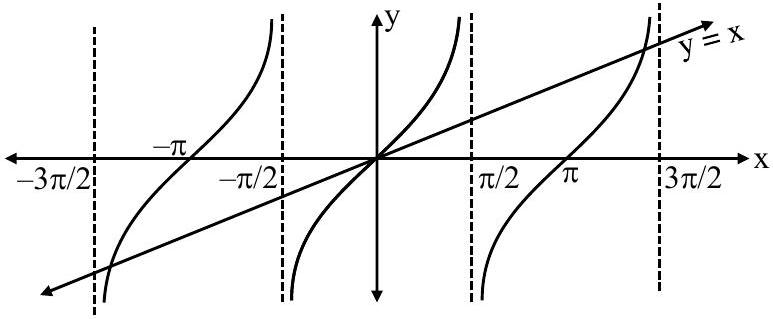
The number of critical points of the function f(x)={∣sin⁡xx∣,x≠01,x=0f(x)=\left\{\begin{matrix}\left|\frac{\sin x}{x}\right|,&x\ne 0\\1,&x=0\end{matrix}\right. in the interval (−2π,2π)(−2π,2π) is equal to:
  1. (A)1
  2. (B)3
  3. (C)5
  4. (D)7
Show answer & solution

Answer: C

lim⁡x→0 ∣sin⁡xx∣=1=f(0)→f(x)\lim\limits_{x\to 0} \left|\frac{\sin x}{x}\right|=1=f(0)\rightarrow f(x) is continuous Now ddx(sin⁡xx)=xcos⁡x−sin⁡xx2\frac{d}{dx}\left(\frac{\sin x}{x}\right)=\frac{x\cos x−\sin x}{x^{2}} ⇒f′(x)=0⇒tan⁡x=x\Rightarrow f^{′}(x)=0\Rightarrow \tan x=x figure 3 solution in (−2π,2π)(−2π,2π) also f′(x)f^{′}(x) does not exist at x=−π,πx=−π,π total 5 points
Solution
Q3JEE Main · 24 Jan 2026 · Shift-II
Consider the following three statements for the function f:(0,∞)→Rf:(0,\infty )\rightarrow R defined by f(x)=∣log⁡ex∣−∣x−1∣:f(x)=\left|\log _{e}x\right|−|x−1|: (I) f is differentiable at all x>0x>0. (II) f is increasing in (0, 1). (III) f is decreasing in (1,∞)(1,\infty ). Then.
  1. (A)All (I), (II) and (III) are TRUE.
  2. (B)Only (I) is TRUE.
  3. (C)Only (II) and (III) are TRUE.
  4. (D)Only (I) and (III) are TRUE.
Show answer & solution

Answer: D

f(x)=∣ln⁡x∣−∣x−1∣={ℓnx−(x−1)x≥1−ℓnx+(x−1)0<x<1={ℓnx−x+1x≥1−ℓnx+x−10<x<1\begin{matrix}&f(x)=|\ln x|−|x−1|\\& =\left\{\begin{matrix}ℓnx−(x−1)&x\geq 1\\−ℓnx+(x−1)&0<x<1\end{matrix}\right.\\& =\left\{\begin{matrix}ℓnx−x+1&x\geq 1\\−ℓnx+x−1&0<x<1\end{matrix}\right.\end{matrix} f′(x)={1x−1x≥1−1x+10<x<1f^{′}(x)=\left\{\begin{matrix}\frac{1}{x}−1&x\geq 1\\−\frac{1}{x}+1&0<x<1\end{matrix}\right. f′(1+)=f′(1−)=0⇒f(x)f^{′}\left(1^{+}\right)=f^{′}\left(1^{−}\right)=0\Rightarrow f(x) is differentiable ∀x>0∀x>0 f′(x)<0∀x>1f′(x)<0∀0<x<1\begin{matrix}f^{′}(x)<0&∀x>1\\f^{′}(x)<0&∀0<x<1\end{matrix} ⇒f(x)\Rightarrow f(x) is decreasing ∀x∈(0,∞)∀x\in (0,\infty ) Option (4)

75 more Monotonicity questions

Practise them free

Practise all 78 Monotonicity PYQs

Untimed with solutions, or as a timed test. Your mistakes are saved so you can retry them.

Start free