JEE Main · Mathematics

Maxima And Minima PYQs

82 previous-year questions from Maxima And Minima in JEE Main, 2014–2026, latest first.

Q1JEE Main · 2 Apr 2026 · Shift-II
Let the parabola y=x2+px+qy=x^{2}+px+q passing through the point (1, −1) be such that the distance between its vertex and the x-axis is minimum. Then the value of p2+q2p^{2}+q^{2} is :
  1. (A)2
  2. (B)4
  3. (C)5
  4. (D)8
Show answer & solution

Answer: B

parabola passes through (1, −1) so −1=1+p+q−1=1+p+q p+q=−2p+q=−2 q=−2−p…(1)q=−2−p …(1) Distance from x-axis −D4a=−(p2−4q)4(1)=4q−p24\frac{−D}{4a}=\frac{−\left(p^{2}−4q\right)}{4(1)}=\frac{4q−p^{2}}{4} =4(−2−p)−p24  from (1) =\frac{4(−2−p)−p^{2}}{4}\text{  from }(1)  =−8−4p−p24=−(p2+4p+8)4=−((p+2)2+4)4=\frac{−8−4p−p^{2}}{4}=\frac{−\left(p^{2}+4p+8\right)}{4}=\frac{−\left((p+2)^{2}+4\right)}{4} Minimum at p=−2⇒q=0p=−2\Rightarrow q=0 p2+q2=4+0=4p^{2}+q^{2}=4+0=4
Q2JEE Main · 2 Apr 2026 · Shift-II
Let f(x) be a polynomial of degree 5, and have extrema at x=1x=1 and x=−1x=−1. If lim⁡x→0 (f(x)x3)=−5\lim\limits_{x\to 0} \left(\frac{f(x)}{x^{3}}\right)=−5, then f(2)−f(−2)f(2)−f(−2) is equal to :
  1. (A)0
  2. (B)50
  3. (C)92
  4. (D)112
Show answer & solution

Answer: D

Given f(x) is a polynomial of degree 5 Also, f′(1)=0;f′(−1)=0f^{′}(1)=0;f^{′}(−1)=0. Also ∵lim⁡x→0 f(x)x3=−5∵\lim\limits_{x\to 0} \frac{f(x)}{x^{3}}=−5 (fixed and finite) ∴f(0)=0;f′(0)=0;f′′(0)=0∴f(0)=0;f^{′}(0)=0;f^{′′}(0)=0 f′′′(0)6=−5⇒f′′′(0)=−30\frac{f^{′′′}(0)}{6}=−5\Rightarrow f^{′′′}(0)=−30 Hence, let f′(x)=(ax+b)(x−0)(x−1)(x+1)f^{′}(x)=(ax+b)(x−0)(x−1)(x+1) ⇒f′(x)=ax4+bx3−ax2−bx\Rightarrow f^{′}(x)=ax^{4}+bx^{3}−ax^{2}−bx f′′(x)=4ax3+3bx2−2ax−bf^{′′}(x)=4ax^{3}+3bx^{2}−2ax−b ∵f′′(0)=0⇒b=0∵f^{′′}(0)=0\Rightarrow b=0 f′′′(x)=12ax2+6bx−2af^{′′′}(x)=12ax^{2}+6bx−2a ∵f′′′(0)=−2a=−30∵f^{′′′}(0)=−2a=−30 ⇒a=15\Rightarrow a=15 ∴f′(x)=15x⋅x⋅(x−1)(x+1)∴f^{′}(x)=15x⋅x⋅(x−1)(x+1) ⇒f′(x)=15x4−15x2\Rightarrow f^{′}(x)=15x^{4}−15x^{2} ⇒f(x)=3x5−5x3+C\Rightarrow f(x)=3x^{5}−5x^{3}+C ∵f(0)=0⇒C=0∵f(0)=0\Rightarrow C=0 ∴f(x)=3x5−5x3∴f(x)=3x^{5}−5x^{3} ∴f(2)−f(−2)=112∴f(2)−f(−2)=112
Q3JEE Main · 28 Jan 2026 · Shift-IINumerical answer
Let f be a differentiable function satisfying f(x)=1−2x+∫0x  e(x−t)f(t)dt,x∈R and let g(x)=∫0x  (f(t)+2)15(t−4)6(t+12)17dt,x∈R.\begin{matrix}&f(x)=1−2x+\int_{0}^{x}  e^{(x−t)}f(t)dt,x\in R\text{ and let }\\&g(x)=\int_{0}^{x}  (f(t)+2)^{15}(t−4)^{6}(t+12)^{17}dt,x\in R.\end{matrix} If p and q are respectively the points of local minima and local maxima of g, then the value of ∣p+q∣|p+q| is equal to ____.
Show answer & solution

Answer: 9

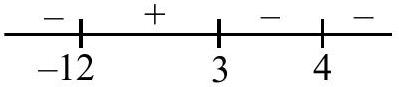
f(x)=1−2x+ex∫0x e−tf(t)dtf(x)=1−2x+e^{x}\int_{0}^{x} e^{−t}f(t)dt e−xf(x)=(1−2x)e−x+∫0x  e−tf(t)dte−xf′(x)−e−xf(x)=−2e−x+(1−2x)e−x(−1)+e−xf(x)f′(x)−2f(x)=2x−3dydx−2y=2x−3⇒y⋅e−2x=∫e−2x(2x−3)dx\begin{matrix}&e^{−x}f(x)=(1−2x)e^{−x}+\int_{0}^{x}  e^{−t}f(t)dt\\&e^{−x}f^{′}(x)−e^{−x}f(x)=−2e^{−x}+(1−2x)e^{−x}(−1)+e^{−x}f(x)\\&f^{′}(x)−2f(x)=2x−3\\&\frac{dy}{dx}−2y=2x−3\\& \Rightarrow y⋅e^{−2x}=\int\limits_{}^{} e^{−2x}(2x−3)dx\end{matrix} On solving we get f(x)=1−xg(x)=∫0x  (3−t)15(t−4)6(t+12)17dtg′(x)=(3−x)15(x−4)6(x+12)17=−(x−3)15(x−4)6(x+12)17\begin{matrix}&f(x)=1−x\\&g(x)=\int_{0}^{x}  (3−t)^{15}(t−4)^{6}(t+12)^{17}dt\\&g^{′}(x)=(3−x)^{15}(x−4)^{6}(x+12)^{17}\\& =−(x−3)^{15}(x−4)^{6}(x+12)^{17}\end{matrix} figure Local maxima ⇒q=3\Rightarrow q=3 Local minima ⇒p=−12⇒∣p+q∣=9\Rightarrow p=−12 \Rightarrow |p+q|=9
Solution

79 more Maxima And Minima questions

Practise them free

Practise all 82 Maxima And Minima PYQs

Untimed with solutions, or as a timed test. Your mistakes are saved so you can retry them.

Start free