Q1JEE Advanced · 17 May 2026 · Paper-1One or more correct
Let ℝ denote the set of all real numbers. Let f : ℝ ℝ be an arbitrary function and let g : ℝ ℝ be the function defined by
g(x) = x f(x), for all x ℝ.
Then which of the following statements is (are) TRUE?
- (A)The function g is always continuous at x = 0
- (B)If f is continuous at x = 0, then g is differentiable at x = 0
- (C)If g is differentiable at x = 0, then f is continuous at x = 0
- (D)If g is differentiable at x = 0, then exists.
Show answer & solutionHide answer
Answer: B, D
(A) Take for x 0, f(0) = 0. Then for x 0 and g(0) = 0, which is not continuous at x = 0.
, which is finite since f is continuous at 0. ∴ g is differentiable at x = 0.
; since g is differentiable at 0, this limit exists, but nothing can be said about f(0). So we cannot conclude continuity of f at 0.
(D) is correct, as shown in (C).
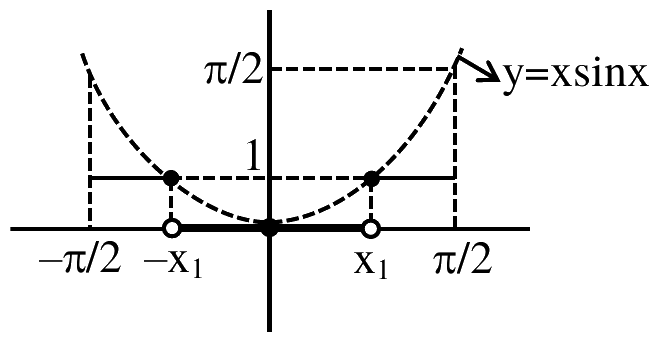 [x sin x] jumps from 0 to 1 where x sin x = 1, i.e. at